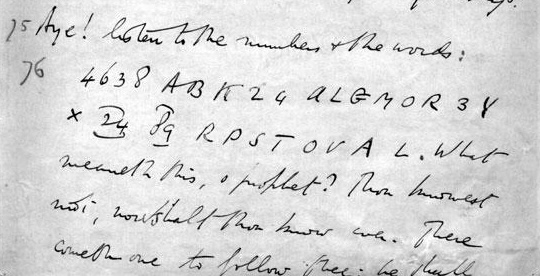
Between April 8 – 10 of 1904, Aleister Crowley sat down at a desk in his apartment in Cairo, Egypt and wrote for one hour between noon and 1 pm for three successive days. He was taking down dictation from a discarnate, preternatural intelligence named “Aiwass” who spoke to him from a corner of the room over his left shoulder. Aiwass first contacted Crowley a few weeks before through Rose Edith, Crowley’s new wife, while the two were on their honeymoon. The contents of what Crowley wrote down between April 8 – 10 became the threefold received text The Book of the Law, the foundational text of Thelema, Crowley’s new religious movement.
At the end of the second day of writing, Aiwass relayed a cipher to Crowley that he embedded at the beginning of verse II. 76 of The Book of the Law (alternately known as Liber AL vel Legis). The rest of that verse indicated to Crowley that he himself would never solve the cipher, a suggestion that proved to be true. But, the passage added, “There cometh one to follow thee: he shall expound it.” The majority of this post relates my solution to that cipher, which I worked on between 2022-24. During that same period, I was weaning myself off the benzodiazepine Klonopin while also working my way through a Kundalini awakening. The II. 76 cipher gave me something constructive to focus on in the middle of a great deal of suffering, and I’m grateful to both Aiwass and Crowley for the opportunity to engage with the thing.
The following solution validates one of Crowley’s central claims about Liber AL, the manner of its reception, as well as its importance to humanity: Aleister Crowley could not have been responsible for the creation of this cipher, nor did he fabricate the text of Liber AL in advance of its reception. The truth is much more remarkable, and I plan to use future blog posts to share as much of it with you as I can. As you’ll soon see, this cipher is too complex to be the work of a human being: Its different parts both interrelate and depend on one another with such coordinated precision that it feels less like a constructed object and more like something that must have been “realized” all at once. Moreover, Aleister Crowley was only 28 years old when he received Liber AL. He never produced anything remotely this complex ever again, and he maintained for the rest of his life that he did not author The Book of the Law nor the puzzles contained within the text.
My goal with this initial post is only to elaborate the structure of the cipher for the reader. With my second post, I’ll share my interpretation of the cipher’s meaning. My present theory is that it communicates information about a concept from quantum physics known as the “fine structure constant,” that this serves to explain the repetition of the number “137” throughout the code. After sharing that interpretation, I’ll use subsequent posts to explore a series of synchronicities that led me to engage with Crowley’s work in the first place. In the summer of 2022, I began to notice unexpected connections between Crowley’s reception of Liber AL in Cairo in 1904 and my own unpublished manuscript of poetry named Hippopotamus. Those synchronicities led me to pick up a copy of Liber AL late in the summer of 2022, at which point I discovered the II. 76 cipher.
Between the synchronicities I mentioned above and how quickly I was able to make substantive progress toward developing the following solution, it’s reasonable to suggest I’m the “one” whom verse II. 76 indicates would come along and “expound” the cipher. The second likeliest story is that I’m the reincarnation of the poet W. B. Yeats, and Crowley catapulted me into the Abyss in an act of posthumous revenge for the events of the Battle of Blythe Road, to which I say, “Good form, Old Crow.” These two possibilities are not necessarily mutually exclusive. In a world of infinite possibility, every story will eventually transform into every other story. From one perspective, this is heat death; from another, immortality.
***
The cipher Crowley received as part of verse II. 76 of The Book of the Law is as follows:
4638 ABK24 aLGMOR 3YX 24 89 RPSTOVAL
I break the code up into five separate sections in my treatment below. In order, those sections are 1) “4638,” 2) “RPSTOVAL,” 3) “3YX 24 89,” 4) “aLGMOR,” and 5) “ABK24.”
I chose this order to help the reader more easily follow along with the cipher’s argument. The principal difficulty in understanding that argument is that the different parts of the cipher work together and interrelate in a manner that is both complex and nonlinear. In subsequent posts, I’ll discuss the meaning of this code. As I wrote above, my goal with this initial post is only to explain its structure to you.
“4638”
These initial four digits signal a correspondence between the set of positive integers and the set of Fibonacci numbers. In addition, they function as a whole number (i.e., “4,638”) we factorize to recover a second piece of information. First, the integer-Fibonacci correspondence:
1	 1
2	 1
3	 2
4	 3
5	 5
6	 8
7	13
Next, we factorize 4,638 to get 2 * 3 * 773. As we’ll see, the cipher makes recurrent use of the prime index of a select group of primes as part of its design. Here, for instance, the number “773” is the 137th prime. If we extend our integer-Fibonacci correspondence indicated by “4638” to include the primes, we find the three digits of 137 a second time:
1	1      2
2	1      3
3	2      5
4	3      7
5	5     11
6	8     13
7      13     17
8      21     19
9      34     23
10     55     29
“RPSTOVAL”
By means of Greek isopsephy, this passage breaks down as follows:
R (rho) = 	 100
P (pi) =     	  80
S (sigma) = 	 200
T (tau) =    	 300
O (omicron) =     70
V (digamma) =      6
A (alpha) =        1
L (lambda) =      30
		 787
The number 787 is the 138th prime. The code, then, begins and ends with a pair of primes whose indices are 137 and 138. This fact, combined with the recurrence of the number 24, suggests the Golden Angle, which is 137.51 degrees, directly in between 137 and 138. The number 24 alludes to 2.4 radians, the value of the Golden Angle expressed in radians. By giving us a range between 137 and 138, the cipher draws our attention to the proximity of two values: The Golden Angle (137.51 degrees) and the reciprocal to the Fine Structure Constant (1/α = ~137.035999177).
“3YX 24 89”
This section revolves around the following calculation:
29^3 = 24,389
The number 29^3 is reversed on the page and appears as “3YX,” while the 3 in the middle of 24,389 is omitted. The cipher presents “29^3” on the page as “392” to foreground its relationship to “RPSTOVAL.” Recalling that the value of that word is 787, we multiply those three numbers together to get the following:
RPSTOVAL = 787 = 7 * 8 * 7 = 392
Next, Aiwass leaves out the middle 3 of 24,389 to emphasize another correspondence: 89 is the 24th prime number. Given that the initial four-digit string “4638” suggested an integer-Fibonacci correspondence, we note here that that the 24th Fibonacci number is 46,368. This is our original “4638” expanded out to five digits: 463(6)8. I’ll note in passing, too, that 89 is both a prime number (Pr 24) and a Fibonacci number (Fib 11).
[Intermission: AL 1.46]
The “3YX” portion of the cipher finds further relevance in an earlier (but still relevant) section of The Book of the Law, verse I. 46:
Nothing is a secret key of this law. Sixty-one the Jews call it; I call it eight, eighty, four hundred & eighteen.
To understand this passage, we need to cover a few pieces of background information. The word Aiwass intends with “sixty-one” is the Hebrew word אין, which we transliterate as “Ain,” meaning “Nothing.” We also need to know that “four hundred & eighteen” is the value in full of the eighth Hebrew letter, Cheth: ח. While the individual letter ח has a value of 8, the word “Cheth” spelled in full is חית, which is 8 + 10 + 400 = 418. The “8, 80” portion of the passage is a bit more involved.
Fourteen years after Crowley received the text, Canadian occultist Charles Stansfield Jones (“Frater Achad”) discovered a “key” to Liber AL that would help Crowley make tremendous progress towards solving its mysteries. Jones’s “key” revolves around the Hebrew word לא, LA, meaning “Nothing.” By gematria, לא is 30 + 1 = 31. Jones’s key involves the gematria-based substitution of Tarot atu values for Hebrew words. Because לא has a value of 31, we can represent this form of “nothing” by combining the Tarot atus XX and XI into XX + XI = XXXI/31. The Hebrew letters that correspond to Atus XX and XI are ש and ט, Shin (Sh) and Teth (T), respectively. We then substitute out לא for those two letters: שט, ShT. This combination, known as the ST ligature, has a value of 309. However, because the ST ligature represents for us the idea of “nothing/לא” we can also assign it an alternate value of 0. With the knowledge that the ST ligature can be both 31 and 0, we can return to verse I. 46 and the “8, 80” section of the passage.
The first thing we need to do is to convert “80” into a pair of Tarot atus: VIII and 0. The Hebrew letters associated to these atus are ל and א; in other words, “80” now brings us back to לא, LA, “nothing.” Now we set 8 and 80 next to one another: 880. Then we substitute “80” for the value of 31, לא. So now our 880 becomes 831. This is the value of Aleph (אלף), the first letter of the Hebrew alphabet. So now we’ve converted “8, 80, 400 & 18” into two values: 831 and 418, א and ח. By basic gematria, this is now 1 + 8 = 9. Our last step is obvious enough: The Coptic word for “nothing” is ⲛⲓⲛⲉ, pronounced “nee-nay.”
The “3YX” section of “3YX 24 89” provides us with an alternate interpretation of verse I. 46’s “8, 80, 400 & 18” in connection to “sixty-one.” First, we recall that 418 is the value of Cheth. In verse I. 46, Aiwass evaluates אין, “Ain,” as 1 + 10 + 50 to arrive at “sixty-one.” However, we can also evaluate אין by using the “nun final” value of 700. That gives us 1 + 10 + 700 = 711. Then we bring in the value “293” from “3YX” and combine it with 418:
418 + 293 = 711, אין, “Nothing.”
We can establish a deeper relationship between 418 and 293, as well. Dividing 418 into 209 + 209, we encounter another value for the ST ligature. As we discussed above, the translation of לא (LA, “Nothing”) into XXXI involves combining Atus XX and XI, which correspond to the Hebrew letters Shin (ש) and Teth (ט), respectively. Those two letters give us 300 + 9 = 309. But we can also translate those two letters into their Greek counterparts, sigma (Σ) and theta (Θ). This sigma-theta combination gives us the 200 + 9 = 209 value we find when we split 418 in half. Accordingly, we can use the ST ligature to express “Abrahadabra” symbolically as “ST + ST.” The equivalence between 418 and 293 follows directly from that expression: Given that 293 is the 62nd prime number, we can also express it by this same formula: “ST + ST,” i.e., “31 + 31.” In this sense, 418 = 293.
At the same time, the “8, 80, 400 & 18” portion of verse I. 46 connects to “293” in an admittedly less convincing manner than what we established in the “Aleph” section above. It’s at least worth mentioning, though. First, we bring in both 293 and 392. Then we separate “8, 80, 400 & 18” into two sets: {400, 8} and {80, 18}. We arrive at 392 by 400 – 8 = 392, and we derive 293 by recourse to its prime index: 80 – 18 = 62 and Pr 62 = 293. That’s an interesting calculation, but it pales in comparison to the fact that the Coptic word for “nothing” is ⲛⲓⲛⲉ, pronounced “nee-nay.”
“aLGMOR”
With “aLGMOR,” I’m going to evaluate the word in the same way I did with “RPSTOVAL,” adding up the letter values by means of Greek isopsephy. But then I’ll also provide and analyze the value of the word spelled in full. After I do this, I’ll swing back around to both “RPSTOVAL” and “ABK” and incorporate the values of those words “spelled in full” into the argument I’m outlining.
The isopsephy for the word is as follows:
A (alpha) = 	    1
L (lambda) = 	   30
G (gamma) = 	    3
M (mu) = 	   40
O (omicron) =      70
R (rho) = 	  100
		  244
Next, we factorize 244 in the same way we did with 4638: 244 = 4 * 61. I’ll mention here, too, that 61 is the 18th prime number—so that when we substitute that number for its index, we have 4 * 18, which reduces to 418, “Abrahadabra.” We have more work to do with “4 * 61,” but first I want to take a step back and derive the value of aLGMOR when we spell that word in full. Here’s that calculation:
A = αλφα = 1 + 30 + 500 + 1 =			532
L = λαμβδα = 30 + 1 + 40 + 2 + 4 + 1 =	         78
G = γαμμα = 3 + 1 + 40 + 40 + 1 = 		 85
M = μυ = 40 + 400 = 				440
O = ομικρον = 70 + 40 + 10 + 20… =		360
R = ρω = 100 + 800 =				900
					       2395
While there are variations in how you can spell both Greek and Hebrew letters, I can confirm the accuracy of that calculation on a few grounds. The primary confirmation comes from Crowley’s own unpublished dictionary of Greek Qabalah, Liber MCCLXIV. A passage in that text indicates “aLGMOR, in full” as 2395. The other justification comes by means of the work we were doing with “aLGMOR” above.
First, we return to the factorization of 244 into 4 * 61. Then, like the “392 = 7 * 8 * 7 = 787” operation, we combine the two factors of 244 into their own unique number: 4 * 61 = 461. I should note here that the number “461” also appears in Crowley’s diary on March 25, 1904, less than two weeks before he received Liber AL. It’s unclear if its presence there is related to the cipher—it appears in the middle of an apparently unrelated set of numbers—but the timing of that appearance is striking. We have more immediate cause for recognizing 461 as a significant number, too: 461 is the 89th prime. We discover, then, that the section of the cipher that reads “24 89” communicates to us both that the 24th prime is 89 and that the 89th prime is 461. By providing us with this “24 : 89 :: 89 : 461” correspondence, the cipher suggests that its solution will involve such iterative mapping.
Returning to the cipher, we repeat this process and treat 461 itself as a prime index: The 461st prime is 3259. Now we can see what makes the word “aLGMOR” so remarkable: By following a set of simple operations legitimized by earlier parts of the cipher, we can derive both 2395 and 3259—two separate permutations of the same four digits—from one six-letter word. In fact, the cipher presents us with a third such permutation hidden at the start of the code: 4638 factorizes to 2 * 3 * 773. If we add those three factors together as 2 + 3 + 773 = 778, we find both a permutation of 787, RPSTOVAL’s value, as well as the prime index of the third permutation of 2395: Prime 778 is 5923.
“ABK24”
The last segment of the cipher for us to analyze is “ABK24.” First, though, a brief aside: In the segment “3YX 24 89” as found in the published facsimile of Liber AL, “24” and “89” are each bound by typographical marks that suggest we take each number as a discrete unit, i.e., as “89,” not as 8 and 9 separately. There’s no such indication with the numbers in “ABK24,” so we should likely take that to mean that the “24” in “ABK24” is not necessarily intended as “twenty-four.”
The isopsephy value of “ABK” is straightforward: 1 + 2 + 20 = 23. If we add the numbers 2 and 4 in, we get 23 + 2 + 4 = 29, a number which has appeared repeatedly throughout the cipher. Next, we’ll spell the letters out in full:
A = αλφα = 1 + 30 + 500 + 1 =		532
Β = Βητα = 2 + 5 + 300 + 1 = 		311
Κ = Καππα = 20 + 1 + 80 + 80 + 1 = 	182
				       1025
Adding in the numbers, we have 1025 + 2 + 4 = 1031. This number is the 173rd prime, an index which is a permutation of 137. This value—1031—turns out, in addition, to be the sum of “RPSTOVAL + aLGMOR”: 787 + 244 = 1031. Furthermore, if we write “ABK” as 23 and set 24 next to it, we have 2324. Permuting those digits to 2423, we obtain the 360th prime. There were also exactly 2,423 days between the August 21, 2017 eclipse and the April 8, 2024 eclipse. We’ll discuss the significance of those eclipses when we explore the synchronicities that led me to engage with Liber AL in the first place. The last calculation left for us is the value in full of RPSTOVAL:
R = ρω = 100 + 800 = 			           900
P = πι = 80 + 10 = 		                    90
S = σιγμα = 200 + 10 + 3 + 40 + 1 = 	           254
T = ταυ = 300 + 1 + 400 = 		           701
O = ομικρον = 70 + 40 + 10 + 20 + 100 + 70 + 50 =   360
V = διγαμμα = 4 + 10 + 3 + 1 + 40 + 40 + 1 =         99
A = αλφα = 1 + 30 + 500 + 1 = 		           532
L = λαμβδα = 30 + 1 + 40 + 2 + 4 + 1 = 	            78
						  3014
The permutation of ABK24’s 2324 into 2423 gave us the 360th prime, and now RPSTOVAL’s value in full, 3014, appears to be an allusion to the beginning of π: 3.14159…. These last two suggestions seem to rest on less sure footing than earlier parts of the cipher, but I’m confident in them because they continue to outline the code’s central focus on the relationship between the Golden Angle and the reciprocal to the Fine Structure Constant. Having derived RPSTOVAL’s value in full, we factorize 3014 to 2 * 11 * 137. Once again, 137 appears. This means that the cipher is not only bookended by 137 and 138 as primes indices: It also ends with that one specific value: 137.
***
As I suggested up above, my sense is that the cipher repeatedly draws our attention to the number 137 because that number signifies the fine structure constant, also known as “alpha.” We encounter 137 in three different forms across the code: 1) As the prime index of 773, the 137th prime; 2) In the prime factorization of 3014, as 2 * 11 * 137; and 3) In the permutation “173,” the prime index of 1031, the value in full of the section “ABK24.” Given that the cipher also establishes a correspondence between the positive integers, the Fibonacci sequence, and the primes, we can consider the “7, 13” extension of the section “4638” to be a likely fourth iteration/permutation of the number. In essence, much of the cipher emphasizes two specific numbers: 137 and 29. My interpretation of the cipher’s meaning revolves around that fact.
If the cipher does focus on the fine structure constant, this realization would be one of the most significant events in human history. I say that because humanity didn’t discover the FSC until Arthur Sommerfeld introduced it in 1916, twelve years after Crowley’s encounter with Aiwass. The code’s focus on the numbers 137 and 29 further suggests familiarity with a specific equation defining alpha that Dr. James Gilson of Queen Mary University of London developed in the late 1990s. My interpretation of the cipher, the focus of my next post, suggests that the cipher explores a set of relationships between the integers 137 and 29 in order to explain why Dr. Gilson’s equation successfully approximates the value of alpha by means of these same two integers, 137 and 29.
Gilson chose those two integers for his equation because they worked, not because he recognized any special relationship between them. The cipher, in turn, explores a set of relationships between these two numbers to hint at the possibility that the value of the fine structure constant may have a geometric and/or number-theoretic origin. This reality would have profound implications for a number of the most fundamental domains of human knowledge, and this would serve to explain why Aiwass would go to such lengths to share the information with Crowley in 1904, one year before Albert Einstein’s “annus mirabilis” in 1905.
Let me conclude this first post with one of my favorite pieces of gematria I’ve discovered over the last few years engaging in this work. When physicists refer to the fine structure constant, they tend to use as shorthand the number 1/137. That’s a close approximation of the constant’s value. The decimal expression of that shorthand, 1/137, is 0.00729927…. The number 927 is the value of the following word in Hebrew: אינסוף. Transliterated as “einsof,” this is the contemporary Hebrew word for “infinity,” independent of religious connotations. Accordingly, the decimal expression for 1/137, a number that describes a constant more fundamental to the nature of reality than perhaps even the speed of light, also serves to express a pair of infinities expanding outward from a common origin:
ףוסניאאינסוף
At the risk of breaking math–a risk, I assure you, I am willing to undertake–I propose that the actual solution to 1/0 is, in fact, ףוסניאאינסוף.
– Zero
***
I’m sharing this project freely with the public because I don’t believe someone’s socioeconomic status should serve as a barrier between them and information of this nature. If you wish to support me and my work, however, that would mean the world to me. Until I get something better set up, please direct any tips or donations to the following platforms:
Paypal: “zer0summ3r@gmail.com”
Venmo: “@zerosummer”
Cash App: “$zerosummer999”
 hippopotamus
Leave a comment